
Euromaidan and Ukraine's Revolution of Dignity
Euromaidan began with flags, songs, and a request that President Viktor Yanukovych keep his promise to sign an agreement with the European Union. It became the Revolution of Dignity after his government answered a small peaceful protest with batons.
The Night That Enlarged the Protest
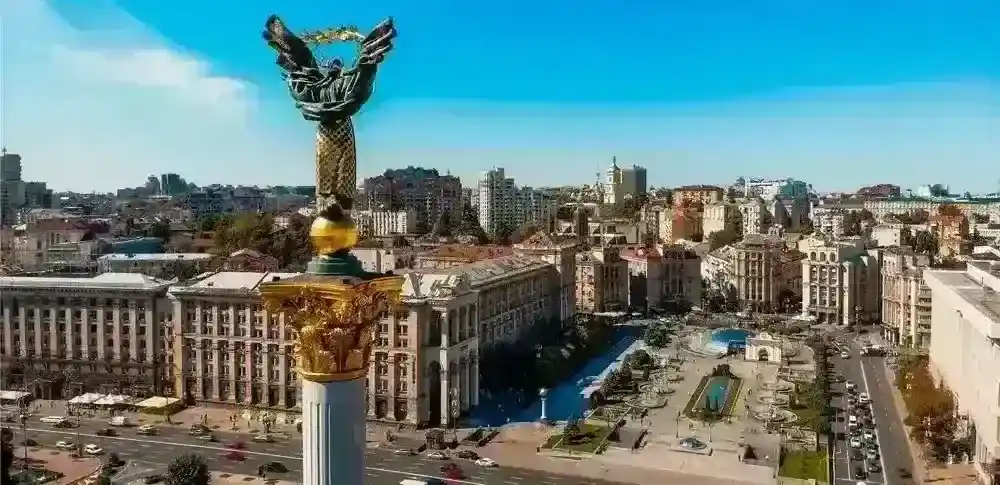
In the early hours of November 30, 2013, Berkut riot police moved onto Kyiv's Maidan Nezalezhnosti and violently dispersed the people who remained, many of them students. Videos showed officers chasing and beating protesters, and some who fled found refuge in St. Michael's Golden-Domed Monastery.
The assault transformed the issue. The next day, an enormous crowd marched through central Kyiv—not only for the suspended EU Association Agreement, but against police impunity and a government that seemed willing to punish peaceful dissent.
Demonstrators reoccupied Maidan and nearby buildings. Protest camps and rallies also appeared around Ukraine, although participation and support varied greatly by region.
Kyiv remained the movement's center, and western regions supplied many long-term participants. Yet surveys and local demonstrations also recorded supporters from central, southern, and eastern Ukraine, complicating the picture of two sealed halves of a country confronting one another.

- Introduces Ukraine through the faces and stories of its people
- Offers visual context for the country beyond breaking-news imagery
- A substantial gift for readers drawn to contemporary Ukrainian life
What People Were Demanding
The European agreement remained an important symbol of the rule-based future many participants wanted. As the movement grew, its demands broadened to include punishment for the November 30 violence, the government's resignation, early elections, limits on presidential power, and an end to entrenched corruption.
“Dignity” captured the connection among those goals. Protesters objected to being treated as subjects who could be beaten, robbed by officials, or denied a voice in the country's direction.
The movement was diverse rather than centrally controlled. Students, professionals, workers, pensioners, veterans, clergy, civic organizations, opposition parties, and people with no party affiliation shared the square without agreeing on every policy.
Life and Power on Maidan
Volunteers built kitchens, clinics, libraries, stages, security patrols, and systems for donations. Tents and barricades turned the square into a functioning protest city, sustained through a bitter Kyiv winter by residents and supporters arriving from elsewhere.
Large Sunday assemblies repeatedly drew hundreds of thousands, while smaller groups staffed the camp between rallies. Churches offered shelter and clergy appeared between opposing lines, and independent media livestreams let people follow events outside state-controlled television.
Three parliamentary opposition leaders—Vitali Klitschko, Arseniy Yatsenyuk, and Oleh Tiahnybok—negotiated with Yanukovych and addressed the crowds. They could influence Maidan but could not simply command it, and protesters sometimes rejected compromises announced from the stage.
Far-right nationalist groups were visible, organized, and increasingly important in confrontations with police. They were one part of a much larger movement, however; surveys found that most participants were not party members, and reducing Euromaidan to its far-right contingent misrepresents who joined and why.
Failed Clearances and Anti-Protest Laws
Authorities tried to push into the encampment again on December 11, but thousands of Kyiv residents arrived overnight and the operation failed. Negotiations continued alongside pressure on activists, court restrictions, and attacks that opponents blamed on government-linked forces.
On January 16, parliament passed a package of laws by a rushed show of hands. The measures sharply restricted protest, penalized tents and convoys, expanded controls on organizations and online speech, and offered new legal tools against the movement.
The laws destroyed what remained of trust. On January 19, clashes erupted near parliament on Hrushevskoho Street, where some protesters threw stones and firebombs while police used stun grenades, rubber bullets, and water cannon in freezing weather.
The first protester deaths followed. The Council of Europe's account later described excessive force, abductions, torture, and violence by both radical protesters and law-enforcement bodies, while emphasizing the state's duty to protect peaceful assembly and investigate abuse.
Toward February
Parliament repealed most of the January laws, the prime minister resigned, and intermittent negotiations produced limited concessions. Maidan remained because protesters did not trust the government to investigate itself or deliver promised political change.
By mid-February, the occupation and barricades had lasted nearly three months. The movement was no longer merely a demonstration about Europe, but it was not yet a change of government.
That final break came during several days of catastrophic violence. The fall of Yanukovych in February 2014 cannot be understood without the deaths, the failed political agreement, his departure from Kyiv, and the parliamentary decisions that followed.
The supporting explainer Was Euromaidan a Coup? separates the constitutional dispute over Yanukovych's removal from claims of a Western seizure of power.

- Traces Ukraine from its earliest history through the modern independent state
- Explains why Kyiv stands at the center of the Eastern European story
- A strong foundation for understanding Ukrainian identity, borders, and politics
Continue with the next article in the sequence:
Return to the chronological outline to browse all chapters.