
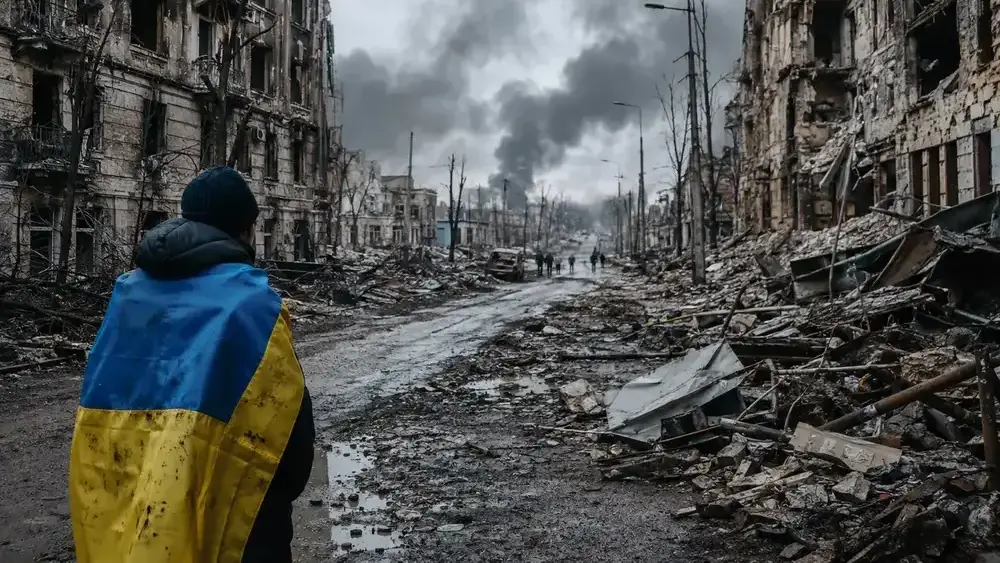
The Ukraine War: A Chronological Outline
- Part I — Independent Ukraine and the Road to Conflict, 1991–2013
- Part II — Russia Seizes Crimea and War Begins in Donbas, 2014
- Part III — Minsk, Occupation and the Unfinished War, 2015–2021
- Part IV — Russia's Full-Scale Invasion, 2022
- Part V — Attrition, Occupation and an Expanding War, 2023–2024
- Part VI — Diplomacy, Escalation and the War Today, 2025–August 2026
- Recommended Supporting Explainers
This section is a chronological guide to the events that shaped the Russia-Ukraine war. It begins with Ukraine's democratic choice for independence in 1991 and follows the conflict through the battlefield, diplomatic, and civilian realities of August 2026.
The articles are deliberately narrow: each explains one turning point, what happened, and why it matters to the larger story. Together they connect treaties, elections, protest, occupation, war in Donbas, failed diplomacy, full-scale invasion, civilian survival, counteroffensives, annexation, long-range strikes, and repeated attempts to negotiate.
This is an outline rather than a complete history, and it will grow as more chapters are added. The sequence below provides a quick route through the articles published so far.
Part I — Independent Ukraine and the Road to Conflict, 1991–2013
How Ukraine Became Independent in 1991 (August–December 1991) — How the failed Soviet coup, Ukraine's declaration, and the December 1991 referendum produced an independent state with support in every region.
Why Crimea Was Part of Independent Ukraine (1954–1991) — Explains why Crimea had been administered by Soviet Ukraine since 1954 and remained inside Ukraine when Soviet republican borders became international ones.
Why Ukraine Gave Up Its Nuclear Weapons (1991–June 1996) — Examines the Soviet arsenal Ukraine inherited, the limits on its operational control, and the negotiations that led Kyiv to disarm.
The Budapest Memorandum: What Russia Promised Ukraine (December 5, 1994) — Sets out the security assurances Russia, the United States, and the United Kingdom gave Ukraine in return for nuclear disarmament.
Russia's Black Sea Fleet and Sevastopol (1992–May 1997) — Explains how Ukraine and Russia divided the Soviet fleet and why Russian naval bases remained on Ukrainian territory.
The 1997 Treaty in Which Russia Recognized Ukraine's Borders (May 31, 1997) — Reviews the treaty in which Russia committed itself to Ukraine's sovereignty, territorial integrity, existing borders, and security.
Tuzla 2003: An Early Territorial Confrontation With Russia (September 29–October 23, 2003) — Recounts how a Russian causeway toward a small Ukrainian island in the Kerch Strait produced a tense border standoff.
The Orange Revolution (November 21–December 26, 2004) — Shows how election fraud brought Ukrainians to Maidan and led the Supreme Court to order a repeat presidential vote.
How Russia Used Gas as Pressure on Ukraine (January 2006 and January 2009) — Explains how prices, debt, pipeline transit, and supply cutoffs made energy both a commercial dispute and a source of geopolitical pressure.
Ukraine, NATO and the 2008 Bucharest Summit (April 3, 2008) — Clarifies that NATO promised eventual membership in principle but offered Ukraine no action plan, timetable, or Article 5 protection.
Why Ukraine Allowed Russia's Fleet to Stay in Crimea (April 21, 2010) — Explains why Yanukovych extended Russia's Crimean base lease through 2042 in exchange for lower gas costs.
2013: Ukraine Chooses Between Europe and Russia (Summer–November 2013) — Traces how an EU association agreement, Russian pressure, and Yanukovych's last-minute reversal brought the first protesters to Maidan.
Euromaidan and Ukraine's Revolution of Dignity (November 21, 2013–February 22, 2014) — Shows how police violence expanded a focused pro-European protest into a mass movement for dignity and accountable government.
February 2014: The Fall of Yanukovych and the Road to Crimea (February 18–27, 2014) — Follows the deadly February clashes, Yanukovych's departure, parliament's interim transfer of power, and Russia's move into Crimea.
Part II — Russia Seizes Crimea and War Begins in Donbas, 2014
How Russia Seized Crimea in 2014 (February–March 2014) — Explains how unmarked Russian forces captured Crimea's institutions, surrounded Ukrainian bases, and established military control before the peninsula's disputed vote.
The Crimean Referendum and Russia's Annexation (March 16–21, 2014) — Examines why the March referendum was unconstitutional, how Russia used it to claim annexation, and why most countries reject the transfer.
Crimea Under Russian Occupation (March 2014–August 2026) — Describes how occupation changed citizenship, law, media, education, Crimean Tatar institutions, and Crimea's role as a Russian military base.
The Russian Spring and the Spread of Unrest in Eastern Ukraine (March–May 2014) — Traces how pro-Russian unrest spread across several cities but became lasting armed separatism only in parts of Donbas.
The DPR and LPR: How the Separatist Entities Were Created (April 6–May 11, 2014) — Explains how building seizures, disputed votes, local participation, and Russian leadership and support produced the self-declared DPR and LPR.
Sloviansk and the Beginning of the Donbas War (April 12–July 5, 2014) — Shows how Igor Girkin's armed seizure of Sloviansk triggered Ukraine's military response and turned unrest into sustained war.
Odesa, 2 May 2014: What Happened (May 2, 2014) — Separates the established evidence about armed clashes, the deadly fire, and state failures from unsupported claims of a government-ordered massacre.
MH17: The Passenger Plane Shot Down Over Donbas (July 17, 2014) — Summarizes how investigators traced the missile system that destroyed MH17 and what the Dutch court established about the attack.
Ilovaisk: The Battle That Exposed Russian Military Intervention (August 10–29, 2014) — Recounts how regular Russian formations encircled Ukrainian forces at Ilovaisk and reversed Ukraine's summer campaign.
The Ilovaisk Green Corridor: The Retreat That Came Under Fire (August 29, 2014) — Follows the Ukrainian troops who attempted a negotiated withdrawal and came under fire, suffering devastating losses.
Minsk I: The First Attempt to Stop the Donbas War (September 5–19, 2014) — Outlines what the September protocol and memorandum required and why their ceasefire quickly unraveled.
The Battle for Donetsk Airport and Ukraine's Cyborgs (May 26, 2014–January 23, 2015) — Tells how Ukrainian defenders held the ruined airport, earned the Cyborgs nickname, and fell during the January 2015 escalation.
Part III — Minsk, Occupation and the Unfinished War, 2015–2021
The Volnovakha Bus Attack (January 13, 2015) — Explains how Grad rockets killed bus passengers near a Ukrainian checkpoint and what OSCE crater analysis established about the direction of fire.
The Mariupol Rocket Attack of January 2015 (January 24, 2015) — Recounts how Grad and Uragan rockets struck Mariupol's Vostochnyi district and were traced to DPR-controlled territory.
The Battle of Debaltseve (January–February 2015) — Follows the encirclement and Ukrainian withdrawal from a strategic railway junction while the Minsk II ceasefire was taking effect.
Minsk II: What the Agreement Actually Said (February 12, 2015) — Sets out the agreement's ceasefire, weapons withdrawal, elections, special status, border control, and foreign-force provisions.
Why the Minsk Agreements Failed (September 2014–February 2022) — Shows how ceasefire violations, conflicting sequences, Russia's disputed role, and weak enforcement prevented a final settlement.
The Forgotten Donbas War, 2015–2021 (2015–2021) — Describes the trench fighting, shelling, sniper fire, mines, military losses, and civilian danger that continued after Minsk II.
Russian Passports and the Integration of Occupied Donbas (February 2017–February 2022) — Traces how Russian money, documents, institutions, elections, and citizenship drew separatist-held territory toward Moscow.
Crimea After Annexation: Militarization and the Kerch Bridge (March 2014–February 2022) — Explains how Russia expanded its military power in Crimea, connected the peninsula by bridge, and tightened control around the Sea of Azov.
The 2018 Kerch Strait Attack and Capture of Ukrainian Sailors (November 25, 2018) — Recounts how Russian forces fired on three Ukrainian naval vessels, captured 24 sailors, and faced international legal proceedings.
Zelenskyy's Attempt to End the Donbas War (2019–July 2020) — Examines prisoner exchanges, troop disengagement, the Steinmeier Formula, and Zelenskyy's first negotiations with Putin.
The 2020 Donbas Ceasefire (July 2020–December 2021) — Explains how stronger rules sharply reduced shooting and casualties before the ceasefire gradually weakened during 2021.
Russia's 2021 Military Buildup Around Ukraine (March–December 2021) — Follows two Russian force concentrations and the equipment, logistics, warnings, and denials that made the second especially dangerous.
Russia's Ultimatums to NATO and the West (December 17, 2021–January 26, 2022) — Sets out Moscow's demands to close NATO's door, restrict allied forces across Eastern Europe, and revise the post-Cold War security order.
Russia Recognizes the DPR and LPR (February 21, 2022) — Explains how Putin's February 21 decision ended the Minsk process and created the immediate political prelude to full-scale invasion.
Part IV — Russia's Full-Scale Invasion, 2022
24 February 2022: Russia Launches Its Full-Scale Invasion (February 24, 2022) — Shows how missiles and ground forces attacked Ukraine from several directions as Russia expanded an eight-year war into a nationwide invasion.
The Battle of Hostomel and Russia's Failed Attack on Kyiv (February 24–April 2, 2022) — Explains how Ukraine contested a vital airport, disrupted Russia's rapid assault plan, and helped force its northern army to withdraw.
The Kyiv TV Tower Strike and Babyn Yar (March 1, 2022) — Recounts the deadly strike on Ukrainian broadcasting and clarifies what was and was not damaged within the historic Babyn Yar landscape.
Irpin: The Battle and the Civilian Escape From Kyiv (February–March 2022) — Follows the defence of Kyiv's northwestern approach and the civilians who crossed a destroyed bridge while shelling continued.
Bucha: What Happened Under Russian Occupation (March 5–30, 2022) — Summarizes the bodies, witnesses, forensic work, and satellite evidence documenting unlawful killings and summary executions.
Borodianka: The Destruction of a Kyiv-Region Town (March 1–2, 2022) — Shows how Russian airstrikes collapsed apartment buildings onto civilians who had taken shelter during the failed attack on Kyiv.
Russia Seizes the Zaporizhzhia Nuclear Power Plant (March 3–4, 2022) — Explains how combat and occupation placed Europe's largest nuclear station, its Ukrainian staff, and vital safety systems inside a war zone.
The Siege of Mariupol (March 1–May 20, 2022) — Traces the encirclement, destruction, collapse of basic services, failed evacuations, and final surrender of defenders at Azovstal.
The Mariupol Maternity Hospital Attack (March 9, 2022) — Reviews the evidence that a Russian airstrike hit an identifiable, operating hospital where pregnant women and medical workers remained.
The Mariupol Drama Theatre Airstrike (March 16, 2022) — Explains why investigators concluded that Russian aircraft struck a theatre sheltering hundreds of civilians despite children markings outside.
Humanitarian Corridors Under Fire (March–May 2022) — Shows why some negotiated routes saved lives while shelling, mines, failed agreements, and battlefield confusion made others dangerously unreliable.
Filtration, Detention and Forced Transfer From Occupied Ukraine (March 2022–August 2026) — Describes how screening, phone searches, detention, family separation, and coerced movement shaped escape from Russian-controlled territory.
The Kramatorsk Railway Station Attack (April 8, 2022) — Reconstructs the Russian cluster-missile strike that killed civilians gathered at a major evacuation point in eastern Ukraine.
The Kremenchuk Shopping Centre Missile Strike (June 27, 2022) — Sets out the video, satellite, and weapons evidence showing that a Russian missile directly hit an operating shopping centre.
Olenivka: The Deaths of Ukrainian Prisoners of War (July 28–29, 2022) — Separates the confirmed deaths and evidence ruling out a HIMARS strike from the still-unresolved cause and responsibility.
Ukraine's Kharkiv Counteroffensive and the Liberation of Izium (September 2022) — Follows Ukraine's rapid September breakthrough and the burial sites and evidence of occupation abuse exposed after liberation.
Russia's 2022 Annexation Referendums (September 23–30, 2022) — Explains how Russia used votes held under military occupation to claim four Ukrainian regions it did not fully control.
Kherson: Russian Occupation and Ukrainian Liberation (March 2–November 11, 2022) — Traces public resistance, repression, Russian administrative control, and the Ukrainian campaign that forced withdrawal across the Dnipro.
Russia's War on Ukraine's Power Grid (October 2022–March 2023) — Describes how missile and drone attacks on energy infrastructure brought blackouts and disrupted heat, water, communications, and daily life.
Part V — Attrition, Occupation and an Expanding War, 2023–2024
The Dnipro Apartment Building Missile Strike (January 14, 2023) — Reconstructs the January 2023 strike that collapsed part of a residential tower and killed 46 people during a nationwide Russian attack.
The Battle of Bakhmut and the Wagner Group (Spring 2022–May 2023) — Explains how months of attritional combat destroyed Bakhmut, elevated Wagner's battlefield role, and consumed extraordinary numbers of troops and shells.
Ukraine's Transferred Children and the ICC Arrest Warrants (February 24, 2022–March 17, 2023) — Examines the transfer of Ukrainian children to Russia, the systems used to place them there, and the war-crimes allegations behind the ICC warrants.
The Destruction of the Kakhovka Dam (June 6, 2023) — Separates established evidence from competing claims about the dam's destruction and follows the flooding, displacement, ecological damage, and water crisis that resulted.
Ukraine's 2023 Counteroffensive (June–October 2023) — Shows why Ukraine's much-anticipated southern campaign made limited gains against deep Russian minefields, fortifications, artillery, and air power.
The Black Sea Grain Deal and Russia's Withdrawal (July 22, 2022–July 17, 2023) — Traces the agreement that reopened Ukrainian grain exports, Russia's July 2023 withdrawal, and Ukraine's creation of an alternative shipping corridor.
Hroza: The Missile Strike on a Funeral Reception (October 5, 2023) — Recounts how a Russian missile hit a village café during a memorial meal, killing 59 people from one small community.
The Battle and Fall of Avdiivka (October 2023–February 17, 2024) — Describes the long fight for the fortified city, Russia's costly final assault, and Ukraine's February 2024 withdrawal under ammunition and manpower pressure.
Russia's 2024 Kharkiv Offensive and the Battle for Vovchansk (May–June 2024) — Follows Russia's cross-border advance, the destruction of Vovchansk, and Ukraine's effort to contain a new front near Kharkiv.
Okhmatdyt: The Strike on Kyiv's Children's Hospital (July 8, 2024) — Reviews the evidence that a Russian Kh-101 cruise missile directly struck Ukraine's largest children's hospital during a nationwide attack.
Ukraine's Kursk Incursion (August 2024–April 2025) — Explains how Ukrainian forces crossed into Russia, seized territory, and created a new bargaining and military challenge on Russian soil.
North Korea Joins Russia's War Effort (2023–August 2026) — Details the shells, missiles, and troops North Korea supplied to Russia and what Pyongyang gained from a closer wartime partnership.
Life Under Russian Occupation (2014–August 2026) — Describes the coercive laws, passport pressure, detention, propaganda, economic control, and quieter forms of resistance shaping occupied communities.
Ukrainian Prisoners of War in Russian Captivity (February 2022–August 2026) — Examines documented torture, isolation, hunger, trials, and the difficult exchange process experienced by Ukrainian prisoners and their families.
The Drone War: How Unmanned Aircraft Changed the Conflict (February 2022–August 2026) — Shows how reconnaissance, first-person-view attack drones, long-range systems, and electronic warfare transformed combat from the front line to distant rear areas.
Part VI — Diplomacy, Escalation and the War Today, 2025–August 2026
Washington Changes Course: U.S. Policy Toward Ukraine in 2025 (January–December 2025) — Traces the Trump administration's pressure on Kyiv, temporary intelligence and aid suspension, minerals agreement, and changing approach to negotiations with Russia.
The 2025 Ceasefire Push: Jeddah, Energy and the Black Sea (March 11–25, 2025) — Explains how a proposed 30-day ceasefire narrowed into partial understandings that never stopped attacks on cities, energy systems, or the front.
The Kryvyi Rih Playground Missile Strike (April 4, 2025) — Reconstructs the Russian ballistic-missile strike that killed adults and children beside homes, restaurants, and a playground in April 2025.
The Sumy Palm Sunday Missile Strike (April 13, 2025) — Examines the double missile strike on central Sumy, the civilian toll, and questions surrounding a Ukrainian military ceremony held in the city.
Istanbul 2025: Russia and Ukraine Resume Direct Talks (May 16–July 23, 2025) — Follows the first direct negotiations since 2022, which produced major prisoner exchanges but exposed incompatible terms for ending the war.
Operation Spiderweb: Ukraine Strikes Russia's Strategic Bomber Fleet (June 1, 2025) — Describes Ukraine's covert drone attack on distant Russian air bases and why assessments of the aircraft damaged or destroyed differ.
The 2025 Battlefield: Russia's War of Attrition and the Fight for Pokrovsk (2025) — Explains how small-unit infiltration, glide bombs, drones, and grinding pressure produced slow Russian gains around a critical Donbas hub.
The 2025 Peace Plans: Territory, Security Guarantees and the Alaska Summit (August–December 2025) — Compares competing proposals over occupied land, NATO, sanctions, ceasefires, and the guarantees Ukraine would receive after any agreement.
Winter 2025–26: Russia Intensifies Attacks on Ukraine's Energy System (Autumn 2025–February 2026) — Shows how massed attacks on electricity, heat, and gas infrastructure made another winter a contest between destruction, air defence, and emergency repair.
The 2026 Abu Dhabi and Geneva Peace Talks (January 23–February 18, 2026) — Reviews the first trilateral rounds involving Ukraine, Russia, and the United States, which enabled exchanges but not agreement on territory or a ceasefire.
Kyiv Under Long-Range Attack, 2022–2026 (February 2022–August 2026) — Follows Kyiv's shift from a threatened ground target to a city enduring increasingly large waves of missiles, drones, interceptions, and falling debris.
Where the Russia–Ukraine War Stands Today (August 20, 2026) — Provides a living snapshot of the front, long-range strikes, diplomacy, military aid, and civilian conditions as of August 20, 2026.
Recommended Supporting Explainers
These articles sit outside the numbered chronology and answer recurring questions about the war's history, terminology, evidence, and legal framework.
Did the Russia–Ukraine War Begin in 2014 or 2022? — Explains why the war began with Crimea and Donbas in 2014 while February 2022 marks its expansion into a full-scale invasion.
Was Euromaidan a Coup? — Separates the legitimate constitutional debate over Yanukovych's removal from unsupported claims that the West simply installed Ukraine's government.
Was NATO Expansion the Cause of Russia's Invasion? — Treats NATO as an important Russian grievance without reducing Moscow's territorial and sovereignty claims to a single cause.
Were Russian Speakers Persecuted in Ukraine? — Distinguishes genuine disputes over language policy from the unsupported claim that people were systematically persecuted for speaking Russian.
Was There a Genocide in Donbas Before 2022? — Explains why real deaths and abuses in the Donbas war did not establish the specific international crime of genocide.
What Does Russia Mean by “Denazification” of Ukraine? — Examines Ukraine's genuine far-right problem and why it does not support portraying the entire state as Nazi-controlled.
Why Is Crimea Internationally Recognized as Part of Ukraine? — Connects Crimea's Soviet transfer, Ukraine's independence, Russian treaties, and the invalid 2014 referendum to its recognized legal status.
Occupation, Annexation and Liberation: What the Terms Mean — Clarifies why military control, a claim of incorporation, and internationally recognized sovereignty are different things.
What Makes an Attack a War Crime? — Outlines how investigators assess targets, distinction, proportionality, precautions, protected people, and individual responsibility.
How Are Civilian Deaths in Ukraine Counted and Verified? — Shows why independently verified totals are conservative minimums that can change as individual cases are confirmed.
What Are Security Guarantees for Ukraine? — Compares political assurances, defence treaties, weapons commitments, monitoring forces, and automatic or discretionary responses.
Why Doesn't Ukraine Hold a Presidential Election During the War? — Explains the martial-law prohibition, constitutional continuity, and practical barriers to a secure and inclusive wartime vote.
How Russian Disinformation About Ukraine Developed — Traces recurring narratives about coups, Nazis, genocide, Russian forces, MH17, and atrocities while offering a practical evidence test.
How to Read a Ukraine War Map Without Being Misled — Explains control, contested areas, terrain, logistics, evidence thresholds, publication delays, and the limits of small territorial changes.